
Engineering Dynamic Microenvironment
for M. I. B.

Materials
(e.g. polymer, hydrogel)
2D / 3D / 4D
fabrication
Functional
nano-/micro structure


Modeling

Integrating

Bridging
1. Modeling Epithelial mechanobiology in vitro
Our research focuses on reconstructing physiologically relevant microenvironments in vitro to systematically investigate epithelial morphomechanics and mechanotransduction. By engineering controllable dynamic systems and biomimetic tissue constructs, we reproduce organ-relevant mechanical conditions that drive multi-scale deformation – from tissue remodeling to intracellular reorganization.
Through integrative approaches, we aim to elucidate the fundamental biomechanical principles governing epithelial morphogenesis and mechanotransductive signaling. This work establishes a quantitative framework for understanding how mechanical environments shapes epithelial tissue development and function.


In vivo epithelial bilayer folding of epithelium-connective tissue


In vitro epithelial bilayer morphomechanics of epithelium-ECM hydrogel

In vitro epithelial mechanotransduction of epithelium-ECM hydrogel
2. Integrating Organoid Culture Platform
Our research focuses on developing physiologically relevant organoid culture platforms that enhance the maturation, functionality, and reproducibility of organ-derived organoids. By engineering biomimetic in vitro microenvironments and integrating electrospinning-based nanofiber fabrication technologies, we create culture systems that promote improved tissue organization and functional development.
Our platforms are designed to support both three-dimensional (3D) organoid culture and two-dimensional (2D) epithelial monolayer formation, enabling organ-specific modeling across diverse tissue types. Built on an insert-based architecture, these systems offer high experimental throughput, robust reproducibility, and flexible integration with other cell types or organ models through straightforward co-culture configurations.


2D / 3D Fabrication
Electrospinning
3D organoid culture platform
2D organoid culture platform

SC-pancreatic-β-cell islets
Kidney organoids
Intestinal organoids
Endometrial organoids

Enhanced maturation & vascularization

Enhanced epithelial monolayer formation
3. Bridging Implantable Tissue Engineering for Regenerative Therapy
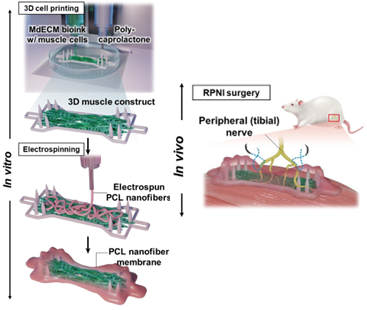
Our research focuses on engineering implantable biomimetic tissue constructs that can function within physiological environments. Using electrospinning-based nanofiber fabrication, we develop three-dimensional architectures that mimic key structural and functional features of native tissues, including hierarchical organization, dynamic mechanical behavior, and biological barrier properties.
By constructing nanofiber-based tissue scaffolds, we aim to recreate physiologically relevant microenvironments that support cellular organization and tissue-level functionality. These engineered architectures provide mechanically stable platforms suitable for implantation and tissue regenerationThrough these approaches, our work seeks to advance implantable nanofiber-based regenerative strategies, enabling engineered tissue systems that bridge biomaterial design, tissue architecture, and therapeutic regeneration.
Hydrogel-Assisted Electrospinning (GelES)


Complex 3D nanofiber fabrication
Nanofiber-Encapsulated Tissue Constructs
Nanofiber Platforms for Transplantation

3D Structuring of Nanofiber Membranes
Nanofiber-Based Organoid Transplantation